
A simple guide to help you report scams across Southeast Asia using official government hotlines and trusted online portals.
Southeast Asia continues to see rapid digital growth and with that comes an increase in scam calls, fake online shops, phishing emails and fraudulent social media accounts.
Whether you live in Malaysia, Singapore, Thailand, Indonesia, Philippines, Brunei, or Vietnam, knowing where to report a scam can protect you and prevent others from falling victim.
This guide lists verified scam-reporting authorities for each country in Southeast Asia, along with their websites, hotline numbers and submission portals.
1.The Scary Report on Financial Losses from Scams in Southeast Asia
Here are several credible reports and references on scam- and fraud-losses in Southeast Asia (SEA) for 2024 and 2025:
| Year | Region / Focus | Loss Figure & Key Details | Source |
|---|---|---|---|
| 2024 | Malaysia | Losses of RM 54.02 billion (~US$12.8 billion) reported | “Combating Scam Syndicates in Malaysia and Southeast Asia” (2025) – Penang Institute) |
| 2024 | Southeast Asia (regional) | Estimated US$10 billion was lost by Americans to SEA-based scam operations (66% increase over prior year). | U.S. government estimate via Office of Foreign Assets Control (OFAC) and others – Chainalysis |
| 2025 | Southeast Asia (region) | Regional study reports losses of approx US$23.6 billion in SEA, average of US$660 lost per adult in 2024. | Global Anti‑Scam Alliance (GASA) “State of Scams in Southeast Asia 2025” – TheNation |
Scam losses in Southeast Asia have skyrocketed over the past three years as reported by United Nations Office on Drugs and Crime and Chainalysis and TheNation.
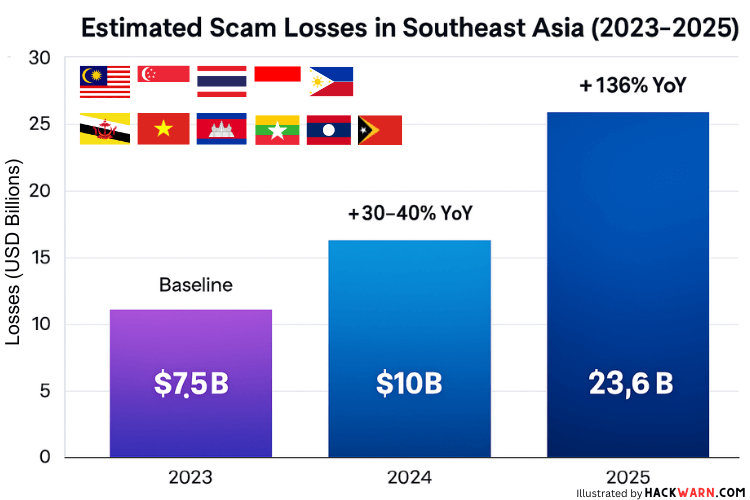
From a baseline of USD 7 – 8 billion in 2023, losses jumped to USD10 billion in 2024, driven by the rapid expansion of online fraud networks.
In 2025, the region saw an unprecedented spike, reaching USD 23.6 billion, a 136% year-on-year increase, highlighting how quickly scam syndicates are scaling their operations.
1. What Types of Scams Can You Report?
The reporting channels below cover these common scam categories:
- Scam websites & fake online stores
- Scam calls pretending to be banks, police or government agencies
- Scam phone numbers
- Scam emails (phishing)
- Scam text messages (SMS, WhatsApp, Telegram, etc.)
- Fake investment platforms
- Online shopping fraud
- Social media impersonation accounts
2. General Steps to Report a Scam in Southeast Asia
- Stop communicating with the scammer immediately.
- Collect evidence (screenshots, URLs, phone numbers, emails).
- Report to the official national portal (see tables below).
- Contact your bank if you shared financial information.
- Block the scam number / email / website.
- Warn family or colleagues, especially seniors or first-time online users.
Read more: Secure Purchase: 5 Best Tools to Protect Online Shopping Scams
3. Scam Reporting Authorities by Country (Southeast Asia)
Below is the verified list of official scam-reporting channels, police portals and national hotlines.
MALAYSIA
To report scam in Malaysia, please use the following guidelines:
| Organization | How to Report | Key Functions |
|---|---|---|
| National Scam Response Centre (NSRC) | Hotline: 997 Website: https://nsrc.rmp.gov.my | The 997 hotline is a 24/7 emergency line for immediate online scam incidents. It is designed to act fast by coordinating with banks and law enforcement to trace, freeze, or recover stolen funds. You should call 997 as soon as you realize you’ve been scammed or accidentally transferred money. It provides rapid response, not long-term case management. |
| CCID Public Checking (Semak Mule) | Website: https://semakmule.rmp.gov.my | A public portal from the Police Commercial Crime Investigation Department that lets users check whether a bank account has been previously reported in scam cases. It helps the public verify sellers and avoid fraud by performing quick due-diligence before making payments. |
| CyberSecurity Malaysia (MyCERT) | Hotline: 1-300-88-2999 Website: https://www.mycert.org.my Email: mycert@cybersecurity.my | A national cybersecurity incident response team that handles a wide range of cyber threats beyond financial scams, including cyberattacks and data breaches. It provides technical support, analysis, and guidance for cybersecurity incidents, complementing NSRC and Semak Mule, which focus mainly on scam-related cases. |
SINGAPORE
To report scam in Singapore, please use the following guidelines:
| Organization | How to Report | Key Functions |
|---|---|---|
| ScamShield | Helpline: 1799 Apps: ScamShield Website: scamalert.sg | 1. Report new scam. 2. Handles scam calls, scam SMS, impersonation scams, investment scams, e-commerce fraud. |
THAILAND
To report scam in Thailand, please use the following guidelines:
| Organization | How to Report | Key Functions |
|---|---|---|
| Anti-Online Scam Operation Center (AOC) | Hotline: 1441 | 24/7 assistance with any online scam example scam calls, fake online shopping, impersonation scams (bank, police, government), fraudulent transfers, social media scams |
| Thai Computer Emergency Response Team (ThaiCERT) | Telephone: 021143531 Website: thaicert.or.th | A national cybersecurity authority that serves as the main point of contact for cyber incidents. It monitors threats, analyzes risks, and issues security alerts. It collects and shares cybersecurity information with government and private sectors, protects Critical Information Infrastructure (CII), and coordinates incident response at national and international levels. It also strengthens cybersecurity awareness through training and provides technical services such as malware analysis, digital forensics, and threat assessment. |
INDONESIA
To report scam in Indonesia, please use the following guidelines:
| Organization | How to Report | Key Functions |
|---|---|---|
| Cybercrime Unit – Indonesian National Police (POLRI) | Hotline: 110 Website: patrolisiber.id Apps: POLRI Super App | Online Scams (impersonation, social media, ransomware, phishing, child pornography, child predators, data falsification, defacement and more) |
| Indonesia Anti Scam Center by Otoritas Jasa Keuangan (OJK) | Call Center: 157 WhatsApp: 081-157-157-157 Website: ojk.go.id Email: humas@ojk.go.id | Investment Fraud (fake investments, illegal fintech) Enforcing strict anti-fraud regulations for all financial institutions. It requires banks and fintech companies to detect, investigate, and report fraud cases quickly, strengthen internal controls such as KYC/AML, and maintain secure whistleblowing channels. OJK also mandates timely fraud incident reporting and can impose heavy penalties including daily fines, suspension, or license revocation on institutions that fail to comply. |
| Bank Indonesia (BI) | Hotline: 131 Website: bi.go.id | Fraudulent Bank/Digital Wallet Transactions |
| Ministry of Communications & IT (Kominfo) | SMS Spam: Forward to 1966 Website: aduancontent.id | Spam SMS or Calls |
PHILIPPINES
To report a scam in Philippines, please use the following guidelines:
| Organization | How to Report | Key Functions |
|---|---|---|
| National Telecommunications Commission (NTC) | Hotline: +63 2 8920 4464 +63 2 8926 7722 +63 2 8921 3251 Email: consumer@ntc.gov.ph Website: ntc.gov.ph. Go to website and click on Text Scam / Spam Report | Accepts reports and works with telecom providers to identify and block fraudulent numbers, making it harder for scammers to operate. |
| Philippine National Police (PNP) Anti-Cybercrime Group (ACG) | PNP ACG: Call 723-0401 loc. 7491 or email acg@pnp.gov.ph. Website; pnp.gov.ph | Enforces cybercrime laws and leads the Philippines’ anti-cybercrime efforts. It investigates all crimes involving the use of information and communication technology whether ICT was used to commit the crime or was the target of the attack. |
| National Bureau of Investigation (NBI) | NBI: Call (02) 8523-8231 or email cybercrime@nbi.gov.ph. | Conducts investigations on a wide range of criminal activities, including cybercrimes. |
BRUNEI
To report a scam in Brunei, please use the following guidelines:
| Organization | How to Report | Key Functions |
|---|---|---|
| Royal Brunei Police Force (RBPF) | Anti-Scam Helpline, 16993 | Provides immediate support to individuals who suspect they have been or may be scammed, including scam verification, pre-reporting advice, and information on common tactics. Helps with prevention and intervention, victims are still advised to file an official police report for a full investigation and legal action. |
| Brunei Darussalam Central Bank (BDCB) | Phone: +673 8380007 Email: fci@bdcb.gov.bn | For submitting complaints about BDCB-licensed financial institutions and reporting unlicensed financial activities or scams. Maintains an “Alert List” of unauthorised or suspicious entities. |
VIETNAM
To report a scam in Vietnam, please use the following guidelines:
| Organization | How to Report | Key Functions |
|---|---|---|
| National Cyber Security Center of Vietnam | Call: 024 3209 1616 | Combating online scams by issuing warnings about deepfake-related fraud and guiding responses to cyberattacks. Promoted cybersecurity awareness through collaboration with various platforms and organizations. |
| People’s Public Security vietnam | Call: +84 28 3930 8045 | Combating online scams through public education, awareness campaigns, and protective measures for citizens and businesses. |
CAMBODIA
To report a scam in Cambodia, please use the following guidelines:
| Organization | How to Report | Key Functions |
|---|---|---|
| General Commissariat of National Police | Hotline Scam 24/7 Website: hotline.police.gov.kh | Provides an online complaint submission, which shortens the time travelling to the police station. |
MYANMAR
To report a scam in Myanmar, please use the following guidelines:
| Organization | How to Report | Key Functions |
|---|---|---|
| Myanmar Emergency Contact | 199 | Reporting crimes, accidents and law inforcement needs |
LAOS
To report a scam in Laos, please use the following guidelines:
| Organization | How to Report | Key Functions |
|---|---|---|
| Lao Computer Emergency Response Team (LaoCERT) | Hotline: +856-30-5764222 Email: report@laocert.gov.la Online Form: laocert.gov.la/incident Website: laocert.gov.la | central point for domestic and international coordination regarding emergency response to cyber incidents. |
TIMOR-LESTE
To report a scam in Timor-Leste, please use the following guidelines:
| Organization | How to Report | Key Functions |
|---|---|---|
| Timor-Leste National Police (PNTL) | Hotline: 112 | For fraud, online deception, money-loss cases, extortion, threats, impersonation, or blackmail, report immediately to the police. |
4. Useful Tips to Stay Safe in Southeast Asia
- Always verify sellers before buying online. Check scam using this website.
- Avoid clicking links sent from unknown WhatsApp numbers.
- Use banks’ official apps rather than SMS links.
- Enable multi-factor authentication (2FA).
- Never share OTP codes, banking PIN, or e-wallet details.
- Search the phone number or website with “scam” before trusting it.
Final Thoughts
Scams continue to evolve, but reporting remains one of the strongest lines of defense. Whether you’re dealing with a scam website, a scam phone number, a fake email, or a fraudulent call, use the official portals above to file your report. Every report helps protect others and disrupt scam networks across the region.
Don’t afraid to report!

5 thoughts on “How to Report a Scam in Southeast Asia (Websites, Calls, Emails & More) 2025 Guide”